Note
Go to the end to download the full example code.
Clustering with Precomputed Distance Matrices
This example demonstrates how to use CLARANS and FastCLARANS with precomputed pairwise distance matrices (metric=’precomputed’), enabling clustering on graph, geodesic, or custom non-Euclidean distance data.

CLARANS Medoids:     [ 4 17 64] | Cost: 582.51
FastCLARANS Medoids: [ 4 17 64] | Cost: 582.51
# Authors: Ngọc Thiện Nguyễn <thiennguyen03001@gmail.com>
# License: MIT

import matplotlib.pyplot as plt
from sklearn.datasets import make_blobs
from sklearn.metrics import pairwise_distances
from clarans import CLARANS, FastCLARANS


X, _ = make_blobs(n_samples=180, centers=3, n_features=4, random_state=42)
# Precompute pairwise Manhattan distances
D = pairwise_distances(X, metric="manhattan")

# Fit CLARANS
model_clarans = CLARANS(n_clusters=3, num_local=3, metric="precomputed", random_state=42)
model_clarans.fit(D)

# Fit FastCLARANS
model_fast = FastCLARANS(n_clusters=3, num_local=3, metric="precomputed", random_state=42)
model_fast.fit(D)

print(
    f"CLARANS Medoids:     {model_clarans.medoid_indices_} | "
    f"Cost: {model_clarans.inertia_:.2f}"
)
print(
    f"FastCLARANS Medoids: {model_fast.medoid_indices_} | "
    f"Cost: {model_fast.inertia_:.2f}"
)

# Distance matrix sorted by cluster assignment
sort_idx = model_clarans.labels_.argsort()
D_sorted = D[sort_idx, :][:, sort_idx]

plt.figure(figsize=(6, 5))
plt.imshow(D_sorted, cmap="viridis", origin="lower")
plt.colorbar(label="Manhattan Distance")
plt.title("Sorted Precomputed Distance Matrix by Clusters")
plt.tight_layout()
plt.show()
Total running time of the script: (0 minutes 0.195 seconds)
Related examples
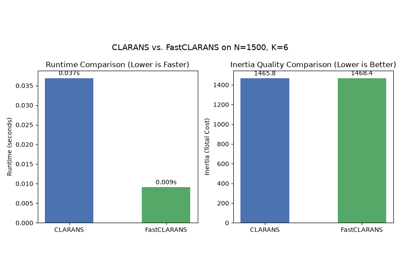
Benchmarking CLARANS vs. FastCLARANS Convergence Speed
Benchmarking CLARANS vs. FastCLARANS Convergence Speed

Clustering on Asymmetric Precomputed Distance Matrices (D != D^T)
Clustering on Asymmetric Precomputed Distance Matrices (D != D^T)

Distance Metrics and Metric Parameters in CLARANS Clustering
Distance Metrics and Metric Parameters in CLARANS Clustering

Clustering Non-Vector Data: Text Sequences with Edit Distance
Clustering Non-Vector Data: Text Sequences with Edit Distance